

 Posts
Posts


I like this blog the most when I think of it as a little clearing house for noteworthy items gleaned from the internet and from the physical world--I feel especially useful when I type up something not readily available on the internet, as in the case of the following letter. It is a letter from Thomas Merton to James Forest, the latter of whom is a Catholic activist and founder of the Catholic Peace Fellowship:
Do not depend on the hope of results. When you are doing the sort of work you have taken on, essentially an apostolic work, you may have to face the fact that your work will be apparently worthless and even achieve no result at all, if not perhaps results opposite to what you expect. As you get used to this idea, you start more and more to concentrate not on the results but on the value, the rightness, the truth of the work itself. And there too a great deal has to be gone through, as gradually you struggle less and less for an idea and more and more for specific people. The range tends to narrow down, but it gets much more real. In the end, it is the reality of personal relationships that saves everything.
You are fed up with words, and I don't blame you. I am nauseated by them sometimes. I am also, to tell the truth nauseated by ideals and with causes. This sounds like heresy, but I think you will understand what I mean. It is so easy to get engrossed with ideas and slogans and myths that in the end one is left holding the bag, empty, with no trace of meaning left in it. And then the temptation is to yell louder than ever in order to make the meaning be there again by magic. Going through this kind of reaction helps you to guard against this. Your system is complaining of too much verbalizing, and it is right.
...[T]he big results are not in your hands or mine, but they suddenly happen, and we can share in them; but there is no point in building our lives on this personal satisfaction which may be denied us and which after all is not that important.
The next step in the process is for you to see that your own thinking about what you are doing is crucially important. You are probably striving to build yourself an identity in your work, out of your work and your witness. You are using it, so to speak, to protect yourself against nothingness, annihilation. That is not the right use of your work. All the good that you will do will come not from you but from the fact that you have allowed yourself, in the obedience of faith, to be used by God's love. Think of this more and gradually you will be free from the need to prove yourself, and you can be more open to the power that will work through you without your knowing it.
The great thing after all is to live, not to pour our your life in the service of a myth: and we turn the best things into myths. If you can get free from the domination of causes and just serve Christ's truth, you will be able to do more and will be less crushed by the inevitable disappointments...
The real hope, then, is not in something we think we can do, but in God who is making something good out of it in some way we cannot see. If we can do His will, we will be helping in this process. But we will not necessarily know all about it beforehand...
Enough of this...it is at least a gesture...I will keep you in my prayers.
All the best in Christ,
Tom

Pebbles flung
I recommend to you this article, entitled "Corporate Priests and Moron Jokes". It was written by a man named Robert Shetterly. In addition to being a writer, Shetterly is a painter. His ongoing portrait series called "Americans Who Tell the Truth" is also worth looking at.
Seven Notes On Ratatouille by Charles Tonderai Mudede
As reprinted from a journal called Arcade (“Architecture and Design in the Northwest”), a copy of which I happened upon yesterday:
The entire meaning of the struggle between humans and rats is this: we produce and store food, and they, the rats, want to eat the food we produce and store.
1. The Rat and Human Problem
Remove the food, and you end the struggle. As the French philosopher Gilles Deleuze pointed out in his book, What Is Philosophy, life no matter what form it takes, is determined by a problem: the bird form has the problem of worms the giraffe from has the problem of leaves, the bee has the problem of flowers, the cow has the problem of grass. These are their problems. Because the rat’s problem happens to be our food, rats themselves present us with a problem. There is no other reason why rats live in our cities, race onto our ships, raid our garbage cans and, worst of all, invade our homes—they are working on their problem, which is our food.
2. A Rat in the Kitchen
The lyrics of a popular song by the British reggae band UB40:
There’s a rat in me kitchen/what am I gonna do?
There’s a rat in me kitchen/what am I gonna do?
I’m gonna fix that rat that/what I’m gonna do…
I’m gonna fix that rat
You invade my space
Make me feel disgraced
And you just don’t give a damn
If I had my way…
I’d like to see you hang…
3. Clean God
For humans, cleanliness is next to Godliness, and the furthest thing from cleanliness, as far as we are concerned, is a rat. Therefore, a rat is the furthest thing from what humans aspire to be: God.
4. The Greatness of Ratatouille
We know that rats have nothing else on their mind than getting at our food. We know they are filthy little creatures. If we see a dead squirrel, we first feel consternation and then concern; a dead bird, even a raven, makes us sad. But a dead rat makes us happy. The only kind of rat we like to see is a dead one. The worst kind of rat we can ever see is one in our kitchen. A rat in the kitchen represents, in the immemorial struggle between humans and rats, the frontline—the final area of combat. This is why Ratatouille is such a great movie. It is nothing less than bold to make a comedy about a rat in a kitchen, a rat in the space that defines the long war between the natural enemies.
5. The Story of Ratatouille
The story is about a tribe of rats that is forced to flee a country home and settle in the city of Paris. One rat in this tribe, Remy, has a strange passion, a dangerous passion, a mad passion, a passion for fine foods. He not only likes to eat good cheeses, rare mushrooms, spices from islands in the Indian Ocean, he also loves to cook. And, to make matters more bizarre, he has a knack for cooking. Remy the rat has a gift for preparing human foods. He doesn’t want to steal food from a kitchen; he wants to cook and serve it to humans. Impossible! Yet the film works. It not only works, it also makes us laugh like there’s no tomorrow. A rat that wants to cook fine foods! Because there is nothing more ridiculous than that idea, that image (a rat stirring a stew), there is nothing more hilarious than Ratatouille.
6. Remy The Great Self-hater
Because Remy the rat loves humans, loves their religion of cleanliness, their sensitivity to beauty, their ability to prepare exquisite dishes—because he loves the things that humans most love about themselves, he hates what he is, a rat. And because he hates rates, he hates himself. What he wants to be is what hates him the most: a human being. And a rat that loves humans (the lover’s of God’s cleanliness) is a rat that hates itself in the most radical way. This is the movie’s dark conclusion: Remy is only lovable because he does not love himself.
7. Passing a building near the corner of Commercial Drive and Main in Vancouver, BC
My lover: See across the street. Two good restaurants right next to each other.
Me: But look what is above them?
My lover: Yes, apartments.
Me: I would hate to live in those apartments.
My lover: Why?
Me: Rats! The place has to be infested with rats. All of the food in storage, in the garbage in the back. The rats can’t help it. They must get inside, get to the food.
The entire meaning of the struggle between humans and rats is this: we produce and store food, and they, the rats, want to eat the food we produce and store.
1. The Rat and Human Problem
Remove the food, and you end the struggle. As the French philosopher Gilles Deleuze pointed out in his book, What Is Philosophy, life no matter what form it takes, is determined by a problem: the bird form has the problem of worms the giraffe from has the problem of leaves, the bee has the problem of flowers, the cow has the problem of grass. These are their problems. Because the rat’s problem happens to be our food, rats themselves present us with a problem. There is no other reason why rats live in our cities, race onto our ships, raid our garbage cans and, worst of all, invade our homes—they are working on their problem, which is our food.
2. A Rat in the Kitchen
The lyrics of a popular song by the British reggae band UB40:
There’s a rat in me kitchen/what am I gonna do?
There’s a rat in me kitchen/what am I gonna do?
I’m gonna fix that rat that/what I’m gonna do…
I’m gonna fix that rat
You invade my space
Make me feel disgraced
And you just don’t give a damn
If I had my way…
I’d like to see you hang…
3. Clean God
For humans, cleanliness is next to Godliness, and the furthest thing from cleanliness, as far as we are concerned, is a rat. Therefore, a rat is the furthest thing from what humans aspire to be: God.
4. The Greatness of Ratatouille
We know that rats have nothing else on their mind than getting at our food. We know they are filthy little creatures. If we see a dead squirrel, we first feel consternation and then concern; a dead bird, even a raven, makes us sad. But a dead rat makes us happy. The only kind of rat we like to see is a dead one. The worst kind of rat we can ever see is one in our kitchen. A rat in the kitchen represents, in the immemorial struggle between humans and rats, the frontline—the final area of combat. This is why Ratatouille is such a great movie. It is nothing less than bold to make a comedy about a rat in a kitchen, a rat in the space that defines the long war between the natural enemies.
5. The Story of Ratatouille
The story is about a tribe of rats that is forced to flee a country home and settle in the city of Paris. One rat in this tribe, Remy, has a strange passion, a dangerous passion, a mad passion, a passion for fine foods. He not only likes to eat good cheeses, rare mushrooms, spices from islands in the Indian Ocean, he also loves to cook. And, to make matters more bizarre, he has a knack for cooking. Remy the rat has a gift for preparing human foods. He doesn’t want to steal food from a kitchen; he wants to cook and serve it to humans. Impossible! Yet the film works. It not only works, it also makes us laugh like there’s no tomorrow. A rat that wants to cook fine foods! Because there is nothing more ridiculous than that idea, that image (a rat stirring a stew), there is nothing more hilarious than Ratatouille.
6. Remy The Great Self-hater
Because Remy the rat loves humans, loves their religion of cleanliness, their sensitivity to beauty, their ability to prepare exquisite dishes—because he loves the things that humans most love about themselves, he hates what he is, a rat. And because he hates rates, he hates himself. What he wants to be is what hates him the most: a human being. And a rat that loves humans (the lover’s of God’s cleanliness) is a rat that hates itself in the most radical way. This is the movie’s dark conclusion: Remy is only lovable because he does not love himself.
7. Passing a building near the corner of Commercial Drive and Main in Vancouver, BC
My lover: See across the street. Two good restaurants right next to each other.
Me: But look what is above them?
My lover: Yes, apartments.
Me: I would hate to live in those apartments.
My lover: Why?
Me: Rats! The place has to be infested with rats. All of the food in storage, in the garbage in the back. The rats can’t help it. They must get inside, get to the food.
Communism, bad ideas, science fiction
In which we wonder on a couple of excerpts from the wonderfully wonder-free first chapter of Kurt Vonnegut's Breakfast of Champions, in which we witness Kurt boiling a world of frustration into a bubbly, gelatinous stew of absurdity:
"When Dwayne Hoover and Kilgore Trout met each other their country was by far the richest and most powerful country on the planet. It had most of the food and minerals and machinery, and it disciplined other countries by threatening to shoot big rockets and them or to drop things on them from airplanes.
"Most other countries didn't have doodley-squat. Many of them weren't even inhabitable anymore. They had too many people and not enough space. They had sold everything that was any good, and there wasn't anything to eat anymore...
"...A lot of the people on the wrecked planet were Communists. They had a theory that what was left of the planet should be shared more or less equally among all the people, who hadn't asked to come to a wrecked planet in the first place... Meanwhile, more babies were arriving all the time--kicking and screaming, yelling for milk. In some places people would actually try to eat mud or such on gravel while babies were being born just a few feet away. And so on.
"Dwayne Hoover's and Kilgore Trout's country, where there was still plenty of everything, was opposed to Communism. It didn't think that Earthlings who had a lot should share it with others unless they really wanted to, and most of them didn't want to. So they didn't have to."
And then a page later:
"The bad ideas were delivered to Dwayne by Kilgore Trout... Here was the core of the bad ideas which Trout gave to Dwayne: Everybody on Earth was a robot, with one exception--Dwayne Hoover.
"Of all the creatures in the Universe, only Dwayne was thinking and feeling and worrying and planning and so on. Nobody else knew what pain was. Nobody else had any choices to make. Everybody else was fully automatic machine, whose purpose was to stimulate Dwayne. Dwayne was a new type of creature being tested by the Creator of the Universe. Only Dwayne had free will.
"Trout did not expect to be believed. He put the bad ideas into a science-fiction novel, and that was where Dwayne found them. The book wasn't addressed to Dwayne alone. Trout had never heard of Dwayne when he wrote it. It was addressed to anybody who happened to open it up. It said to simply anybody, in effect, "Hey--guess what: You're the only creature with free will. How does that make you feel?" And so on.
"It was a tour de force. It was a jeu d'espirit."
"When Dwayne Hoover and Kilgore Trout met each other their country was by far the richest and most powerful country on the planet. It had most of the food and minerals and machinery, and it disciplined other countries by threatening to shoot big rockets and them or to drop things on them from airplanes.
"Most other countries didn't have doodley-squat. Many of them weren't even inhabitable anymore. They had too many people and not enough space. They had sold everything that was any good, and there wasn't anything to eat anymore...
"...A lot of the people on the wrecked planet were Communists. They had a theory that what was left of the planet should be shared more or less equally among all the people, who hadn't asked to come to a wrecked planet in the first place... Meanwhile, more babies were arriving all the time--kicking and screaming, yelling for milk. In some places people would actually try to eat mud or such on gravel while babies were being born just a few feet away. And so on.
"Dwayne Hoover's and Kilgore Trout's country, where there was still plenty of everything, was opposed to Communism. It didn't think that Earthlings who had a lot should share it with others unless they really wanted to, and most of them didn't want to. So they didn't have to."
And then a page later:
"The bad ideas were delivered to Dwayne by Kilgore Trout... Here was the core of the bad ideas which Trout gave to Dwayne: Everybody on Earth was a robot, with one exception--Dwayne Hoover.
"Of all the creatures in the Universe, only Dwayne was thinking and feeling and worrying and planning and so on. Nobody else knew what pain was. Nobody else had any choices to make. Everybody else was fully automatic machine, whose purpose was to stimulate Dwayne. Dwayne was a new type of creature being tested by the Creator of the Universe. Only Dwayne had free will.
"Trout did not expect to be believed. He put the bad ideas into a science-fiction novel, and that was where Dwayne found them. The book wasn't addressed to Dwayne alone. Trout had never heard of Dwayne when he wrote it. It was addressed to anybody who happened to open it up. It said to simply anybody, in effect, "Hey--guess what: You're the only creature with free will. How does that make you feel?" And so on.
"It was a tour de force. It was a jeu d'espirit."
The whole world salivating
Adam Wiltzie, musician, on why it took six years for his band to release an album:
"What I learnt was essentially in the past (or I should say around finishing Tired Sounds) I was pretty fatigued, mentally. I wondered why I felt it was so necessary to make a record every year, or to be in the endless cycle of recording, then touring, and then starting over again. I reckon that, in general, musicians can fool themselves into thinking the whole world salivates for more new music, and the result is letting that false sense of reality push them into releasing music that is not really finished, or just to make the release date their label wants them to make so as to beat the Christmas rush, et cetera. So, some people will pre-suppose that six years is a long time to wait to release a new record. But I do not buy into that assumption."
And later, responding to a question about his influences:
"As I may have said, it is painfully uncomfortable for me to talk about my body of work with any sort of reverence..."
Maybe a portion of the world was salivating for a new Stars of the Lid album. But my hope is that Adam Wiltzie is among a perhaps small number of entertainers who are reasonably suspicious of the dysfunctionally co-dependent relationship of fan and celebrity. Such co-dependent cycles can be broken if one of the two parties are willing to call BS.
"What I learnt was essentially in the past (or I should say around finishing Tired Sounds) I was pretty fatigued, mentally. I wondered why I felt it was so necessary to make a record every year, or to be in the endless cycle of recording, then touring, and then starting over again. I reckon that, in general, musicians can fool themselves into thinking the whole world salivates for more new music, and the result is letting that false sense of reality push them into releasing music that is not really finished, or just to make the release date their label wants them to make so as to beat the Christmas rush, et cetera. So, some people will pre-suppose that six years is a long time to wait to release a new record. But I do not buy into that assumption."
And later, responding to a question about his influences:
"As I may have said, it is painfully uncomfortable for me to talk about my body of work with any sort of reverence..."
Maybe a portion of the world was salivating for a new Stars of the Lid album. But my hope is that Adam Wiltzie is among a perhaps small number of entertainers who are reasonably suspicious of the dysfunctionally co-dependent relationship of fan and celebrity. Such co-dependent cycles can be broken if one of the two parties are willing to call BS.
Three Questions
A fictional character once said:
“Remember then: there is only one time that is important—Now! It is the most important time because it is the only time when we have any power. The most necessary man is he with whom you are, for no man knows whether he will have any dealings with any one else: and the most important affair is, to do him good, because for that purpose alone was man sent into this life!”
It's worth reading Leo Tolstoy's whole short story, of which this quote is the conclusion. The story is called "Three Questions" and it can be found in the Tolstoy compilation "Walk In The Light And Twenty-Three Tales," available here for free because clearly the folks over at the Plough Publishing House have been reading a little too much Tolstoy.
“Remember then: there is only one time that is important—Now! It is the most important time because it is the only time when we have any power. The most necessary man is he with whom you are, for no man knows whether he will have any dealings with any one else: and the most important affair is, to do him good, because for that purpose alone was man sent into this life!”
It's worth reading Leo Tolstoy's whole short story, of which this quote is the conclusion. The story is called "Three Questions" and it can be found in the Tolstoy compilation "Walk In The Light And Twenty-Three Tales," available here for free because clearly the folks over at the Plough Publishing House have been reading a little too much Tolstoy.
August 9, 1945
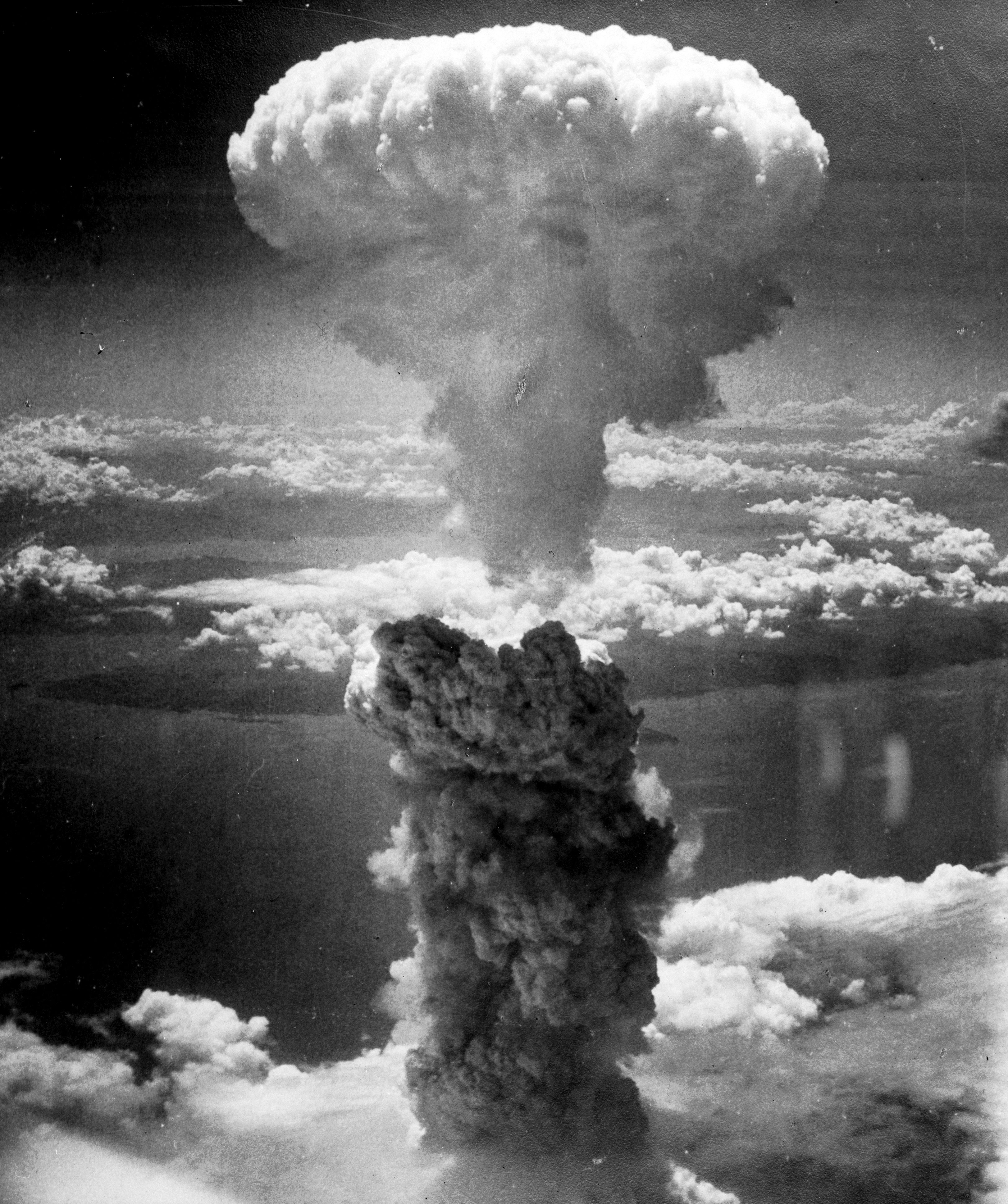
We loved our bomb. We had such affection for the tidy, miraculous work of our hands. We wanted to give him a nickname, an enduring testament to our cleverness. We called him Fat Man.
On the ground, 73,844 Japanese people called him sudden death. 74,909 more called him a lifetime of physical suffering.
Today, 62 years later, we might call him a reminder to pray for a world in which the destruction of innocent human lives on a catastrophic scale is still considered an effective means of conflict resolution. (Only if diplomatic measures fail, mind you).
The desire to pick up weapons that we're not really prepared to handle is only one manifestation of our giddy faith in technological control as the solution to all problems. Let's get off the frenzied, promise-laden bandwagon of the Next Big Thing and learn to use, with love and patience, the means we already have in front of us.
On the ground, 73,844 Japanese people called him sudden death. 74,909 more called him a lifetime of physical suffering.
Today, 62 years later, we might call him a reminder to pray for a world in which the destruction of innocent human lives on a catastrophic scale is still considered an effective means of conflict resolution. (Only if diplomatic measures fail, mind you).
The desire to pick up weapons that we're not really prepared to handle is only one manifestation of our giddy faith in technological control as the solution to all problems. Let's get off the frenzied, promise-laden bandwagon of the Next Big Thing and learn to use, with love and patience, the means we already have in front of us.
Thinking about music with Brian Eno
Brian Eno was born in the village of Woodbridge, Suffolk, on May 15, 1948 and educated by nuns and Brothers of the De La Salle order until he was 16 - at which point he enrolled for a two-year course at Ipswich Art School.
"I went to art school because I didn't want to do a conventional job. I saw a job as a trap and something to avoid. In fact, that's a characteristic of my life: making moves not so much towards things as away from them, avoiding them."
Although young Brian knew he didn't want to be ordinary, his conceptions were, at that point quite as ordinary as those of his fellow students. He was in need of a shake-up.
"By a stroke of luck I happened to go to a very good school. Ipswich was run by a guy called Roy Ascot - a very brilliant educationalist, I think - and what he and his staff were concerned with was not the teaching of technique so much as experimenting with notions of what constitutes creative behaviour.
"So, instead of sitting there doing little paintings, we found ourselves being required to get involved in discussions and self-investigation projects. Like, the first thing we had to do was a 'mind-map', which was constructing a series of tests to find out what sort of behaviour we exhibited in different situations, from which it was decided what sort of character type we each were .
"Having established that, we had to behave in a way diametrically opposed to our normal selves, ie., if you were naturally extrovert, you had to be introvert; if you were a born leader, you had to be a follower, etc."
Which were you?
"I had to become a follower. I had to execute everyone else's ideas, not make a fuss, not try to dominate the proceedings.
"Some people really pushed it. One girl was very perky and exuberant and the only way she could get herself to calm down was to tie her legs to her chair. Another girl, called Lily, was very nervous - she made herself learn how to walk the tight-rope.
"I sat on this porter's trolley all day. If anyone wanted me to do anything, they had to wheel me to where I was required.
"All of this was very exciting and disorientating and aroused in me a lasting interest in working with other people under what might normally be considered quite artificial restrictions."
During this period, Eno met a major influence in the artist Tom Phillips, who was one of the staff, and began to get interested in music via a chance encounter with John Cage's book Silence and the occasional visit to the school of avant-garde composer Cornelius Cardew.
Unable, as yet, to manipulate a conventional musical instrument, he started playing about with tape-recorders and, by 1965 - at which juncture he left Ipswich for Winchester Art School - he had amassed about 30 machines, of which only two were in full working order.
Winchester was a traditional institution and Eno found his newly-inspired experimentalism forced underground. The staff and most of the other students made no secret of finding him rather odd.
"I felt that art was more serious and important than they seemed to think. They regarded it as merely decorative - or there to make things a bit better or something. I thought there was much more to it, but I couldn't then put my finger on it.
"Also, there was my mother-in-law - a very bright woman, a logician into scientific method - who'd always say to me things like 'I can't understand why somebody with your mind is wasting his time doing this'. She was very cutting about it indeed.
"So I was forced into justifying my position and that started what has been a continuous train of thinking over the last ten years."
*From New Musical Express, November 26th, 1977
Here's the full article.
"I went to art school because I didn't want to do a conventional job. I saw a job as a trap and something to avoid. In fact, that's a characteristic of my life: making moves not so much towards things as away from them, avoiding them."
Although young Brian knew he didn't want to be ordinary, his conceptions were, at that point quite as ordinary as those of his fellow students. He was in need of a shake-up.
"By a stroke of luck I happened to go to a very good school. Ipswich was run by a guy called Roy Ascot - a very brilliant educationalist, I think - and what he and his staff were concerned with was not the teaching of technique so much as experimenting with notions of what constitutes creative behaviour.
"So, instead of sitting there doing little paintings, we found ourselves being required to get involved in discussions and self-investigation projects. Like, the first thing we had to do was a 'mind-map', which was constructing a series of tests to find out what sort of behaviour we exhibited in different situations, from which it was decided what sort of character type we each were .
"Having established that, we had to behave in a way diametrically opposed to our normal selves, ie., if you were naturally extrovert, you had to be introvert; if you were a born leader, you had to be a follower, etc."
Which were you?
"I had to become a follower. I had to execute everyone else's ideas, not make a fuss, not try to dominate the proceedings.
"Some people really pushed it. One girl was very perky and exuberant and the only way she could get herself to calm down was to tie her legs to her chair. Another girl, called Lily, was very nervous - she made herself learn how to walk the tight-rope.
"I sat on this porter's trolley all day. If anyone wanted me to do anything, they had to wheel me to where I was required.
"All of this was very exciting and disorientating and aroused in me a lasting interest in working with other people under what might normally be considered quite artificial restrictions."
During this period, Eno met a major influence in the artist Tom Phillips, who was one of the staff, and began to get interested in music via a chance encounter with John Cage's book Silence and the occasional visit to the school of avant-garde composer Cornelius Cardew.
Unable, as yet, to manipulate a conventional musical instrument, he started playing about with tape-recorders and, by 1965 - at which juncture he left Ipswich for Winchester Art School - he had amassed about 30 machines, of which only two were in full working order.
Winchester was a traditional institution and Eno found his newly-inspired experimentalism forced underground. The staff and most of the other students made no secret of finding him rather odd.
"I felt that art was more serious and important than they seemed to think. They regarded it as merely decorative - or there to make things a bit better or something. I thought there was much more to it, but I couldn't then put my finger on it.
"Also, there was my mother-in-law - a very bright woman, a logician into scientific method - who'd always say to me things like 'I can't understand why somebody with your mind is wasting his time doing this'. She was very cutting about it indeed.
"So I was forced into justifying my position and that started what has been a continuous train of thinking over the last ten years."
*From New Musical Express, November 26th, 1977
Here's the full article.
“ ”
Dostoyevsky's monk says:
"Love in practice is a harsh and dreadful thing compared to love in dreams."
"Love in practice is a harsh and dreadful thing compared to love in dreams."
Intolerable beauty
The band Radiohead always gives me good links to online photography.
A couple of years ago they alerted me to The Daily Nice, a simple page that provides a new, usually-interesting photo every day. It's been the default page on my web browser ever since.
Now they've directed me to the online portfolio of Chris Jordan, which I think is pretty remarkable, particularly his "Intolerable Beauty" series.
A couple of years ago they alerted me to The Daily Nice, a simple page that provides a new, usually-interesting photo every day. It's been the default page on my web browser ever since.
Now they've directed me to the online portfolio of Chris Jordan, which I think is pretty remarkable, particularly his "Intolerable Beauty" series.


Two kinds of technology
Here's a nice distinction between two kinds of technology from Theodore Kaczynski's "Industrial Society and Its Future":
"We distinguish between two kinds of technology, which we will call small-scale technology and organization-dependent technology. Small-scale technology is technology that can be used by small-scale communities without outside assistance. Organization-dependent technology is technology that depends on large-scale social organization. We are aware of no significant cases of regression in small-scale technology. But organization-dependent technology DOES regress when the social organization on which it depends breaks down. Example: When the Roman Empire fell apart the Romans' small-scale technology survived because any clever village craftsman could build, for instance, a water wheel, any skilled smith could make steel by Roman methods, and so forth. But the Romans' organization-dependent technology DID regress. Their aqueducts fell into disrepair and were never rebuilt. Their techniques of road construction were lost. The Roman system of urban sanitation was forgotten, so that only until rather recent times did the sanitation of European cities equal that of Ancient Rome.
"The reason why technology has seemed always to progress is that, until perhaps a century or two before the Industrial Revolution, most technology was small-scale technology. But most of the technology developed since the Industrial Revolution is organization-dependent technology. Take the refrigerator for example. Without factory-made parts or the facilities of a post-industrial machine shop it would be virtually impossible for a handful of local craftsmen to build a refrigerator. If by some miracle they did succeed in building one it would be useless to them without a reliable source of electric power. So they would have to dam a stream and build a generator. Generators require large amounts of copper wire. Imagine trying to make that wire without modern machinery. And where would they get a gas suitable for refrigeration? It would be much easier to build an ice house or preserve food by drying or picking, as was done before the invention of the refrigerator."
Other good sections are the part where Kaczynski profiles leftists as "oversocialized" individuals and the part where he talks about the profusion of increasingly empty "surrogate activities" in an industrialized society in order to feed the natural human desire to accomplish meaningful work.
"We distinguish between two kinds of technology, which we will call small-scale technology and organization-dependent technology. Small-scale technology is technology that can be used by small-scale communities without outside assistance. Organization-dependent technology is technology that depends on large-scale social organization. We are aware of no significant cases of regression in small-scale technology. But organization-dependent technology DOES regress when the social organization on which it depends breaks down. Example: When the Roman Empire fell apart the Romans' small-scale technology survived because any clever village craftsman could build, for instance, a water wheel, any skilled smith could make steel by Roman methods, and so forth. But the Romans' organization-dependent technology DID regress. Their aqueducts fell into disrepair and were never rebuilt. Their techniques of road construction were lost. The Roman system of urban sanitation was forgotten, so that only until rather recent times did the sanitation of European cities equal that of Ancient Rome.
"The reason why technology has seemed always to progress is that, until perhaps a century or two before the Industrial Revolution, most technology was small-scale technology. But most of the technology developed since the Industrial Revolution is organization-dependent technology. Take the refrigerator for example. Without factory-made parts or the facilities of a post-industrial machine shop it would be virtually impossible for a handful of local craftsmen to build a refrigerator. If by some miracle they did succeed in building one it would be useless to them without a reliable source of electric power. So they would have to dam a stream and build a generator. Generators require large amounts of copper wire. Imagine trying to make that wire without modern machinery. And where would they get a gas suitable for refrigeration? It would be much easier to build an ice house or preserve food by drying or picking, as was done before the invention of the refrigerator."
Other good sections are the part where Kaczynski profiles leftists as "oversocialized" individuals and the part where he talks about the profusion of increasingly empty "surrogate activities" in an industrialized society in order to feed the natural human desire to accomplish meaningful work.
Today on the way to work my daily bus-time reveries were interrupted by the gentleman sitting next to me, who quietly and somewhat sheepishly brought to my attention the fact that I bear an uncanny resemblance to Sylar, a character on the hit NBC television series Heroes.
It was the second time a complete stranger on public transportation has informed me of this fact and the fourth time in five days that someone I've been introduced to has mentioned the resemblance.
I don't watch the show but apparently Sylar is an arch-villain who controls people and things with his brain. I suppose this association creates an unfortunate social hurdle for me, or an advantage, depending on the situation.
See what you think:
Exhibit A
Exhibit B
Exhibit C
Exhibit D
It was the second time a complete stranger on public transportation has informed me of this fact and the fourth time in five days that someone I've been introduced to has mentioned the resemblance.
I don't watch the show but apparently Sylar is an arch-villain who controls people and things with his brain. I suppose this association creates an unfortunate social hurdle for me, or an advantage, depending on the situation.
See what you think:
Exhibit A
Exhibit B
Exhibit C
Exhibit D
Price tags
In the ideology of capitalism, the value and meaning of all things is understood by the dollar amount that the almighty market confers upon them. We may be queasy about evaluating the price of a human life in terms of money, but there is no doubt that this sort of evaluation can and is being done. It is, after all, the final frontier in a long history of capitalizations (or "privatizations") that include plots of land, song lyrics, certain plant seed cross-breeds, quantities of pollution, the lives of animals, the holy bible, and the one-click online shopping experience. And the color burgundy, as Robb discovered the other day while looking at the packaging of a bag of shredded cheese from the store--burgundy is trademarked as the "trade dress" of food manufacturer Sargento.
Granted that capitalism is a deeply rooted way of understanding the world that you and I most likely share (to one degree or another), it can be revealing to step completely inside of this value system for a moment in order to take a look at our values. Or, in other words, to put a mouth where our money is; a money-mouth that is capable of bluntly telling us what we care about: Tom Engelhardt compares the market value of an American life versus that of our fellow humans who happened to be born on other parts of the earth.
Granted that capitalism is a deeply rooted way of understanding the world that you and I most likely share (to one degree or another), it can be revealing to step completely inside of this value system for a moment in order to take a look at our values. Or, in other words, to put a mouth where our money is; a money-mouth that is capable of bluntly telling us what we care about: Tom Engelhardt compares the market value of an American life versus that of our fellow humans who happened to be born on other parts of the earth.
Whitecaps of white noise
Fitting that Canadian sound explorer Tim Hecker sculpts seven and a half minutes of almost completely undifferentiated fuzz into a track called "The Work of Art in an Age of Cultural Overproduction." Fitting because he realizes that one has to start dealing with the reality of life in a big, viscous glut of cultural junk.
Obviously the social condition of cultural obesity has something to do with the fact that the primary way that I, an individual here in the beating heart of the media empire, am able to come to terms with my own identity is to cross the coveted threshold from media consumer to media producer. To lay down some tracks, to shoot and edit a film, to write a book (my memoirs!), to be interviewed on some documentary, to put some dumb video of myself online.
But in what sense is it socially desirable to add my voice or your voice to the already deafening roar of cultural white noise? There are too many records. Too many films showing in too many theaters. Too much must-see video programming. Too many new releases, too many staff picks, too many best-sellers. Too many logos, too much smart design play, too many fonts, too many slick magazines, and way too many clever advertising concepts. Too many photos taken of ourselves and too many of our friends in interesting places and positions, too many attempts at interesting angles. Too much data accessible on too many PDAs at any time and any place. Too many people eating lunch alone, accompanied only by one of those wireless cell phone earpieces. Too many mp3s. Too many "relevant" churches posting too many sermon podcasts to be played back on too many video iPods. Too many blogs with too many posts. And too many sleek Apple laptops cranking out this blather.
Maybe in some way cultural production can still be valid, but I can't imagine any worthwhile piece of art that doesn't first respond to it's relationship to all of the other cultural, virtual, enticing, bite-size media bits trying to edge it out for a second of our attention. Which is why tediously slow washes of barely harmonic sound that demand at least an hour of listening time is about all the cultural product that I can keep down these days.
And I know that the right thing to do is to not get so easily seduced into the belief that I exist to propagate of my own "unique" perspective on the world via the free market apparatus.
But I do get so easily seduced. And I start to make things. And I start to recommend cultural product like the artists above or the video below as an antidote to an overload of cultural product. Why do I do it, the thing I don't want to do?
Obviously the social condition of cultural obesity has something to do with the fact that the primary way that I, an individual here in the beating heart of the media empire, am able to come to terms with my own identity is to cross the coveted threshold from media consumer to media producer. To lay down some tracks, to shoot and edit a film, to write a book (my memoirs!), to be interviewed on some documentary, to put some dumb video of myself online.
But in what sense is it socially desirable to add my voice or your voice to the already deafening roar of cultural white noise? There are too many records. Too many films showing in too many theaters. Too much must-see video programming. Too many new releases, too many staff picks, too many best-sellers. Too many logos, too much smart design play, too many fonts, too many slick magazines, and way too many clever advertising concepts. Too many photos taken of ourselves and too many of our friends in interesting places and positions, too many attempts at interesting angles. Too much data accessible on too many PDAs at any time and any place. Too many people eating lunch alone, accompanied only by one of those wireless cell phone earpieces. Too many mp3s. Too many "relevant" churches posting too many sermon podcasts to be played back on too many video iPods. Too many blogs with too many posts. And too many sleek Apple laptops cranking out this blather.
Maybe in some way cultural production can still be valid, but I can't imagine any worthwhile piece of art that doesn't first respond to it's relationship to all of the other cultural, virtual, enticing, bite-size media bits trying to edge it out for a second of our attention. Which is why tediously slow washes of barely harmonic sound that demand at least an hour of listening time is about all the cultural product that I can keep down these days.
And I know that the right thing to do is to not get so easily seduced into the belief that I exist to propagate of my own "unique" perspective on the world via the free market apparatus.
But I do get so easily seduced. And I start to make things. And I start to recommend cultural product like the artists above or the video below as an antidote to an overload of cultural product. Why do I do it, the thing I don't want to do?
Cardinal Arinze & Co.
Here is an article I arrived at via a roundabout path starting at the blog of an acquaintance from last spring.
Summarizing his 2002 book, The Next Christendom, historian Philip Jenkins makes the sociological case that Christianity is headed for major crisis in the next few hundred years as the bulk of its constituency shifts from Europe and America towards the global south, where hierarchy and communal values are in order, homosexuality is clearly a sin, and Jesus' ministry is interpreted with an emphasis on healing and spiritual warfare.
And as a sidenote, thanks to the King County Library System, whose subscription to ProQuest has enabled me to share this and other articles of note with you. In other, less libraried quarters of the internet it could cost you $5 to read such an article.
Summarizing his 2002 book, The Next Christendom, historian Philip Jenkins makes the sociological case that Christianity is headed for major crisis in the next few hundred years as the bulk of its constituency shifts from Europe and America towards the global south, where hierarchy and communal values are in order, homosexuality is clearly a sin, and Jesus' ministry is interpreted with an emphasis on healing and spiritual warfare.
And as a sidenote, thanks to the King County Library System, whose subscription to ProQuest has enabled me to share this and other articles of note with you. In other, less libraried quarters of the internet it could cost you $5 to read such an article.
Unfocused reflections on taking part in protest
Since I made a post a while back with some pre-emptory thoughts on this Christian Peace Witness for Iraq event that happened in the middle of March, I wanted to follow up with some retrospection.
And since Davis beat me to the topic with a prickly little rant about some protests in NYC that he read about last month, perhaps I can respond using his post as an entry point. He sums up well the persistent, tiring sense of disappointment that have underlaid my experience at both of the protests I've witnessed, one last September in which I was merely a man behind a camera, and this time as a participant. My immediate hesitancy to embrace these public marches has been certainly due to what Davis identifies as "theatricality," which is the right word for it. I think this is a direct result of reluctant acceptance on the part of protest organizers of the average American's "event reality" being highly mediated by, well, the media: If a tree falls on a mime in the forest, does it make a sound? Likewise, if 3,000 protesters march from the National Cathedral to the White House on a Friday night around midnight, if the president is at Camp David for the weekend and only a few hundred pedestrians witness the event and a handfull of newspapers carry the story--did it ever really happen? Well, in the awareness of most Americans, no, it never did.
So last September at the White House, there was a certain palpable tense expectancy on the part of the organizers... would Senator Jim McGovern actually show up and get arrested? Were lots of anti-war people going to gather from all over and turn this into a Big Deal that NBC couldn't ignore? Or would this party turn out to be for only 8 "independent news" cameras and the 15 endorsers of the document?
Apparently left at the mercy of the media, protesters attempt to creatively introduce various degrees of theatricality: Staging "die-ins" at senators' offices, pouring dyed blood into rivers, or some going so far as to collect their own blood and pour it on the interior of a military recruitment center. In the case of last September, a team of moderately well-known organization leaders marched up to the white house gates, claiming that they won't leave until President Bush meets with them and signs on to their troop-withdrawal terms. The anti-climax comes after 3 hours of sitting on the sidewalk singing old protest songs, when a bunch of police officers that have been standing around announce that everyone who doesn't leave right now is going to be arrested for creating a "safety hazard" by sitting on the sidewalk for too long. An edict which also happens to include one angry, party-crashing bystander on a soap box exposing her breasts with a sign reading "War Is Indecent."
Set against the immortalized drama of the 60s that those gingerly-sung songs reference--thousands of working-class leaving work to march for miles down the street singing spirituals while being provoked and attacked by police and heckled by crowds of pissed-off, status-quo-enforcing onlookers--it's quite a let-down. In fact, I think the prospect of marching against war with hundreds of old, earth-tone-clad, gentle liberals is exactly what drives all of those wild-n-crazy anarchist kids to gear up in militaristic black paraphernalia and strike out at cops whenever they organize enough to get out on the streets.
The reality of my experience with war protests is that the compromise (that utterly terrifying confrontation with The Mundane) that seems to inevitably result from any large-scale communal activity is something that an impatient idealist such as myself just has to get used to on some level. Of course, this is where I have to disagree with Davis, who writes off those NY die-in protesters as self-serving rebels without a cause. In fact, in my experience it's really hard to stay excited on rebellious sentiment when one is faced with almost completely uninterested/unphased audience. And the odd angry patriot shouting from a car. And finally the television-saturated pedestrian who is flabbergastedly documenting the event on a camera phone, startled, barely believing that he is witnessing something in person that one would usually see on television (hence the irresistible urge to commit the experience into a medium that will finally render it comprehensible).
On the contrary, I have a lot of respect for the tenacity of anyone who can hold on to their moral beliefs after glancing into the bored eyes of city-dweller after city-dweller, and finally a cop who can't wait for this technical exercise in zip-tie-ing limp bodies to be over... and then proceed do it again and again. Besides, most of the people I've seen get arrested are over the age of 50. Middle-finger-raisers? Not likely. Pietists? Perhaps, but then anyone who's acting out what they believe in is in danger of being a self-serving pietist. But for that matter, perhaps your average, apathetic couch-potato, watching the evening news and your latte-sipping i-banker, rushing off to work, could use just a trace of piety. I guess the attempt to rouse others from complete and utter apathy becomes the main goal of most contemporary protests in our neck of the woods.
Which brings me to March's Christian Witness for Peace event. Just about everyone I knew who went with me to D.C. had long-since worn through the enamor of their first glorious march. (We had to grit our teeth when someone quoted Martin Luther King Jr. saying that in order to be successful, nonviolent activists must exercise endless energy and creativity in their cause to effectively counter the ingrained momentum of years and years of belief in the redemptive value of violent force).
All that said, the worship service in the National Cathedral was one of the most moving services I've been to in quite a while, highlighted by beautiful music and a few wonderful speakers. It was encouraging to gather with several thousand other Christians, as Christians, to collectively mourn our government's careless, hasty militarism. As it has been pointed out before, the history of international military conflict is marked almost without exception by confident church endorsements on every side, so it's nice to see at least a small part of the American church developing a voice that is at least able call into question rote national allegiance. So while the march itself was more a simulation of civil disobedience than an effective tool for change, I chose to take the event for what it was--a symbolic gesture--and appreciate it for that.
Real galvanizing protest, such as what happened in the 60s around civil rights, takes a lot of built-up pressure as well as a widespread collective agreement, besides all of the top-down creativity. My own judgment about this messy situation in Iraq, along with that of many other people, would need to crystallize before we could all expect to see something both big and compelling enough to get the average American onto the streets. But judging by the conformity backlash we're currently experiencing, I'd say we've got some more time to sit and mull over our what it means to be an American, maybe 5 or 10 or 15 years and a few more catastrophes before a significant portion are ready to really freak out again. Until then, protest will probably continue to look like bland fringe activity to most of us.
But then again there's the small-scale dynamic stuff.
If you're interested, the following items represent the rather modest media footprint of the March event:
Some photos
Fox News 5 coverage (featuring a wildly-haired moment with Dimitri)
A compilation of all of the print coverage
And since Davis beat me to the topic with a prickly little rant about some protests in NYC that he read about last month, perhaps I can respond using his post as an entry point. He sums up well the persistent, tiring sense of disappointment that have underlaid my experience at both of the protests I've witnessed, one last September in which I was merely a man behind a camera, and this time as a participant. My immediate hesitancy to embrace these public marches has been certainly due to what Davis identifies as "theatricality," which is the right word for it. I think this is a direct result of reluctant acceptance on the part of protest organizers of the average American's "event reality" being highly mediated by, well, the media: If a tree falls on a mime in the forest, does it make a sound? Likewise, if 3,000 protesters march from the National Cathedral to the White House on a Friday night around midnight, if the president is at Camp David for the weekend and only a few hundred pedestrians witness the event and a handfull of newspapers carry the story--did it ever really happen? Well, in the awareness of most Americans, no, it never did.
So last September at the White House, there was a certain palpable tense expectancy on the part of the organizers... would Senator Jim McGovern actually show up and get arrested? Were lots of anti-war people going to gather from all over and turn this into a Big Deal that NBC couldn't ignore? Or would this party turn out to be for only 8 "independent news" cameras and the 15 endorsers of the document?
Apparently left at the mercy of the media, protesters attempt to creatively introduce various degrees of theatricality: Staging "die-ins" at senators' offices, pouring dyed blood into rivers, or some going so far as to collect their own blood and pour it on the interior of a military recruitment center. In the case of last September, a team of moderately well-known organization leaders marched up to the white house gates, claiming that they won't leave until President Bush meets with them and signs on to their troop-withdrawal terms. The anti-climax comes after 3 hours of sitting on the sidewalk singing old protest songs, when a bunch of police officers that have been standing around announce that everyone who doesn't leave right now is going to be arrested for creating a "safety hazard" by sitting on the sidewalk for too long. An edict which also happens to include one angry, party-crashing bystander on a soap box exposing her breasts with a sign reading "War Is Indecent."
Set against the immortalized drama of the 60s that those gingerly-sung songs reference--thousands of working-class leaving work to march for miles down the street singing spirituals while being provoked and attacked by police and heckled by crowds of pissed-off, status-quo-enforcing onlookers--it's quite a let-down. In fact, I think the prospect of marching against war with hundreds of old, earth-tone-clad, gentle liberals is exactly what drives all of those wild-n-crazy anarchist kids to gear up in militaristic black paraphernalia and strike out at cops whenever they organize enough to get out on the streets.
The reality of my experience with war protests is that the compromise (that utterly terrifying confrontation with The Mundane) that seems to inevitably result from any large-scale communal activity is something that an impatient idealist such as myself just has to get used to on some level. Of course, this is where I have to disagree with Davis, who writes off those NY die-in protesters as self-serving rebels without a cause. In fact, in my experience it's really hard to stay excited on rebellious sentiment when one is faced with almost completely uninterested/unphased audience. And the odd angry patriot shouting from a car. And finally the television-saturated pedestrian who is flabbergastedly documenting the event on a camera phone, startled, barely believing that he is witnessing something in person that one would usually see on television (hence the irresistible urge to commit the experience into a medium that will finally render it comprehensible).
On the contrary, I have a lot of respect for the tenacity of anyone who can hold on to their moral beliefs after glancing into the bored eyes of city-dweller after city-dweller, and finally a cop who can't wait for this technical exercise in zip-tie-ing limp bodies to be over... and then proceed do it again and again. Besides, most of the people I've seen get arrested are over the age of 50. Middle-finger-raisers? Not likely. Pietists? Perhaps, but then anyone who's acting out what they believe in is in danger of being a self-serving pietist. But for that matter, perhaps your average, apathetic couch-potato, watching the evening news and your latte-sipping i-banker, rushing off to work, could use just a trace of piety. I guess the attempt to rouse others from complete and utter apathy becomes the main goal of most contemporary protests in our neck of the woods.
Which brings me to March's Christian Witness for Peace event. Just about everyone I knew who went with me to D.C. had long-since worn through the enamor of their first glorious march. (We had to grit our teeth when someone quoted Martin Luther King Jr. saying that in order to be successful, nonviolent activists must exercise endless energy and creativity in their cause to effectively counter the ingrained momentum of years and years of belief in the redemptive value of violent force).
All that said, the worship service in the National Cathedral was one of the most moving services I've been to in quite a while, highlighted by beautiful music and a few wonderful speakers. It was encouraging to gather with several thousand other Christians, as Christians, to collectively mourn our government's careless, hasty militarism. As it has been pointed out before, the history of international military conflict is marked almost without exception by confident church endorsements on every side, so it's nice to see at least a small part of the American church developing a voice that is at least able call into question rote national allegiance. So while the march itself was more a simulation of civil disobedience than an effective tool for change, I chose to take the event for what it was--a symbolic gesture--and appreciate it for that.
Real galvanizing protest, such as what happened in the 60s around civil rights, takes a lot of built-up pressure as well as a widespread collective agreement, besides all of the top-down creativity. My own judgment about this messy situation in Iraq, along with that of many other people, would need to crystallize before we could all expect to see something both big and compelling enough to get the average American onto the streets. But judging by the conformity backlash we're currently experiencing, I'd say we've got some more time to sit and mull over our what it means to be an American, maybe 5 or 10 or 15 years and a few more catastrophes before a significant portion are ready to really freak out again. Until then, protest will probably continue to look like bland fringe activity to most of us.
But then again there's the small-scale dynamic stuff.
If you're interested, the following items represent the rather modest media footprint of the March event:
Some photos
Fox News 5 coverage (featuring a wildly-haired moment with Dimitri)
A compilation of all of the print coverage
Upbeat 1962 pre-assassination innocence
Here's an article by David Brooks called "The Organizational Kid" from 2001 that is worth a read. It's basically a profile of my generation as it faces the college and early career years. I would say that it resonates strongly with my own experience.
Subscribe to:
Comments (Atom)